A post by spect says SpaceXAI released a free 53-minute workshop showing how its go-to-market team organizes Grok Bots. The outline starts with giving each bot one clear job, then moves through inbox and meeting preparation, prospect research, outreach, parallel tasks and onboarding.
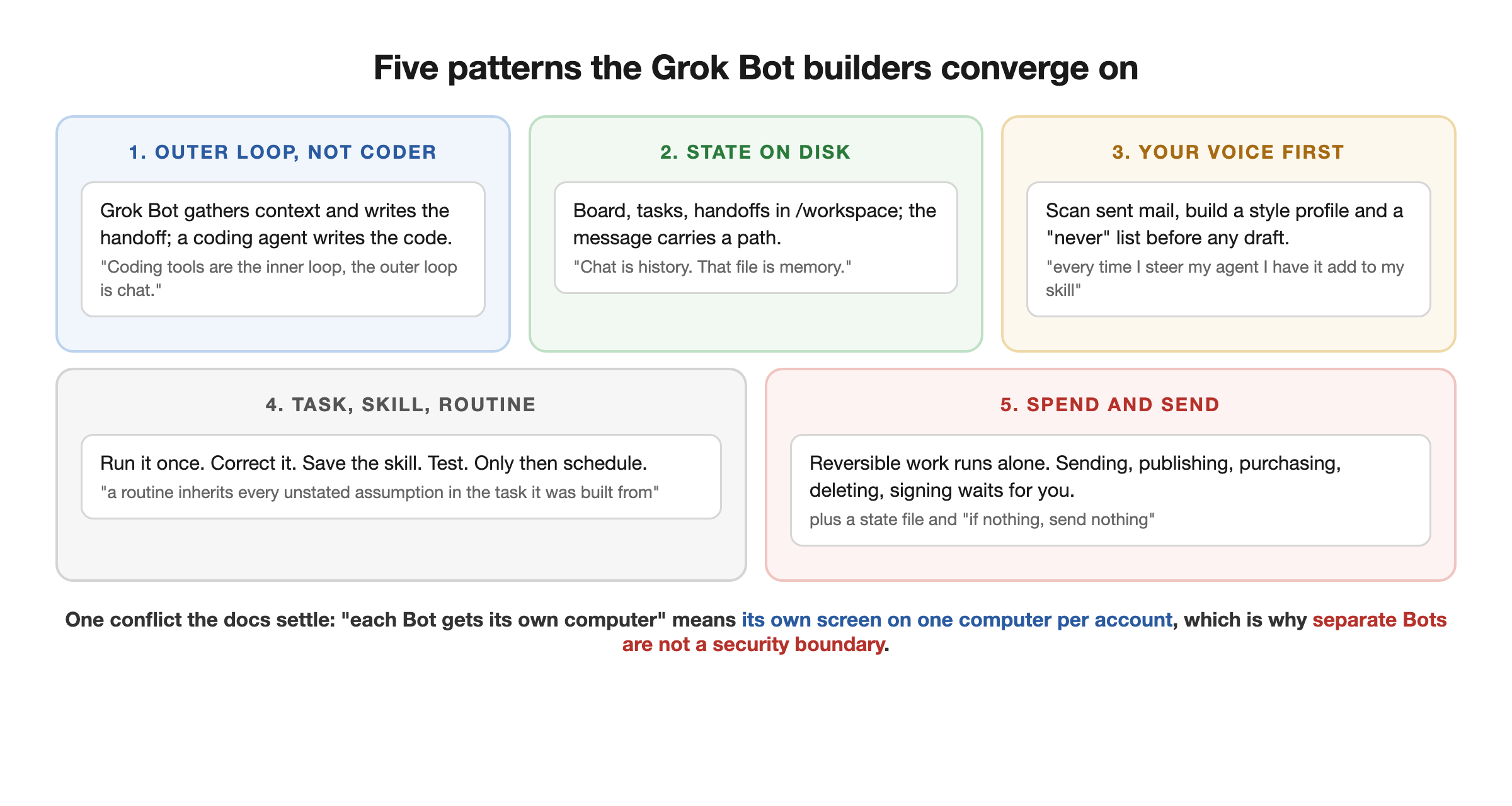
The post summarizes the setup as “role → tools → skill → feedback → routine.” In that model, a broad workflow is divided among specialized bots instead of one general-purpose agent planning and executing everything. Elon Musk reposted the workshop claim, but the supplied posts do not independently verify the workshop's contents or results.
A team model with human review
A post from distort identifies Lauren Tan as a SpaceXAI engineer and quotes her as saying more than 10 “Chiefs of Staff” run her agents around the clock while she reviews their work each morning. Both the identity and the quote are presented secondhand in the post.
As described, the human still reviews the work while several bots handle narrow responsibilities in parallel. The posts present an operating method, not a benchmark showing that it outperforms a single general-purpose agent.
Treat the bot like a new hire
Brian Roemmele's guide applies the same structure to onboarding a bot. He recommends writing a one-sentence job description, defining what the bot may and may not do, running a text-only trial, and requiring three probation runs before expanding its responsibilities. He also recommends approval gates for consequential actions.
The Grok account echoed that checklist, including a one-sentence job, explicit boundaries, a text trial, three probation runs and a weekly review. Musk separately called Roemmele's article a helpful guide to hiring a first Grok Bot employee.
Together, the posts frame multi-bot automation less like writing one clever prompt and more like managing a small team: distinct jobs, limited permissions, repeated evaluation and human approval where mistakes would matter.