• Home
  • Technology
  • Gaming
  • Entertainment
  • World & Business
  • Science
  • Sports
  • AI
HomeTechnologyGamingEntertainmentWorld & BusinessScienceSportsAI
AI
Reaction

Code contracts as a proposed middle ground between informal specs and formal verification

In a DotAI 2026 talk, a developer argues that code remains essential to understanding and maintaining critical business systems, even if people no longer write it themselves.

1 Source, 11d ago, first seen 11d ago

TLDR

The developer argues that fully verifying all code is unrealistic, but informal specifications alone are not enough to maintain critical systems. They propose “code contracts”: structured, free-form specifications kept alongside code, with automation to flag important violations. They say this approach could help engineers understand changes and keep specifications from drifting away from the code.

Combined views

—

1 Source, first seen 11d ago

— likes— comments— saves— reposts

Combined views

—

1 Source, first seen 11d ago

— likes— comments— saves— reposts

Sentiment

Positive——Negative

Summary

Not enough discussion yet.

No sentiment analysis available yet.

Featured Source

Sentiment

Positive——Negative

Summary

Not enough discussion yet.

No sentiment analysis available yet.

Related

Desargues gets @spolu's backing; a canonical Lean benchmark is in the works

A post says @spolu backed Desargues and that its author is building a public benchmark for canonical Lean, pointing to minif2f as an example of what such a benchmark can do for a field.

A proof-quality benchmark for Lean is reportedly in development

A user points to the Desargues team’s work and argues that proving involves taste, style and “interestingness” as well as correctness.

1 Source

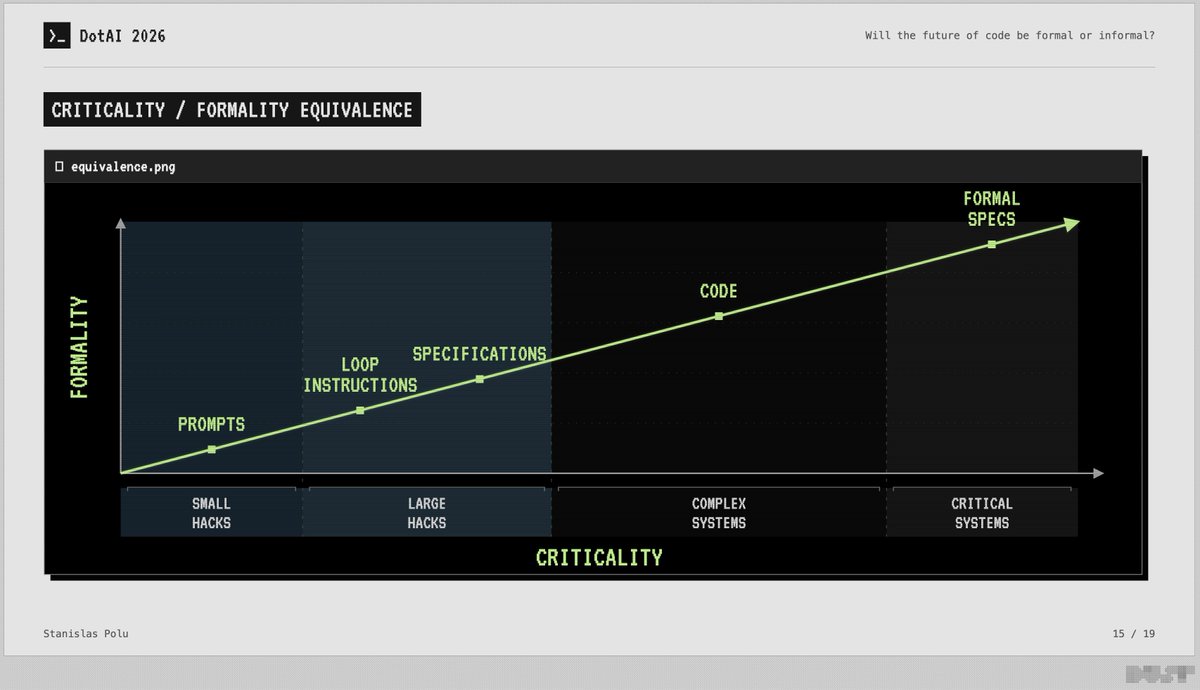
Stanislas Polu@spoluFull talk at DotAI 2026 on code contracts and why I believe code will remain the artefact we use to build and understand our future software systems (even if we don't write it). Vibe coding and spec driven dev / light off software factories have extended the line on the criticalitly/formality graph, but if you're maintaining a critical business system, code will remain the only valid artefact possible to understand it: you don't understand a system if you can't maintain it, and no, a set of informal product and architecture specifications is not "maintainable". Call me old-school, but if I'm the one getting paged at 4am, I sure as hell won't let you vibe code your way in my codebase or send a swarm of light-off agents to deface it. Slides: https://app.dust.tt/share/frame/2cefce6a-6027-4464-89e8-9e789520fefb Video: https://www.youtube.com/watch?v=eg8u-0102lw&list=PLRAlryTpyNiU&index=1311d
    • Home
    • Technology
    • Gaming
    • Entertainment
    • World & Business
    • Science
    • Sports
    • AI
    Stanislas Polu

    1 Source

    Stanislas Polu@spoluFull talk at DotAI 2026 on code contracts and why I believe code will remain the artefact we use to build and understand our future software systems (even if we don't write it). Vibe coding and spec driven dev / light off software factories have extended the line on the criticalitly/formality graph, but if you're maintaining a critical business system, code will remain the only valid artefact possible to understand it: you don't understand a system if you can't maintain it, and no, a set of informal product and architecture specifications is not "maintainable". Call me old-school, but if I'm the one getting paged at 4am, I sure as hell won't let you vibe code your way in my codebase or send a swarm of light-off agents to deface it. Slides: https://app.dust.tt/share/frame/2cefce6a-6027-4464-89e8-9e789520fefb Video: https://www.youtube.com/watch?v=eg8u-0102lw&list=PLRAlryTpyNiU&index=1311d
    Today's Rank

    —

    Not ranked yet

    Today's Rank

    —

    Not ranked yet