• Home
  • Technology
  • Gaming
  • Entertainment
  • World & Business
  • Science
  • Sports
  • AI
HomeTechnologyGamingEntertainmentWorld & BusinessScienceSportsAI
AI
Report

Agensh reportedly coordinates 1,024 coding agents without a central orchestrator

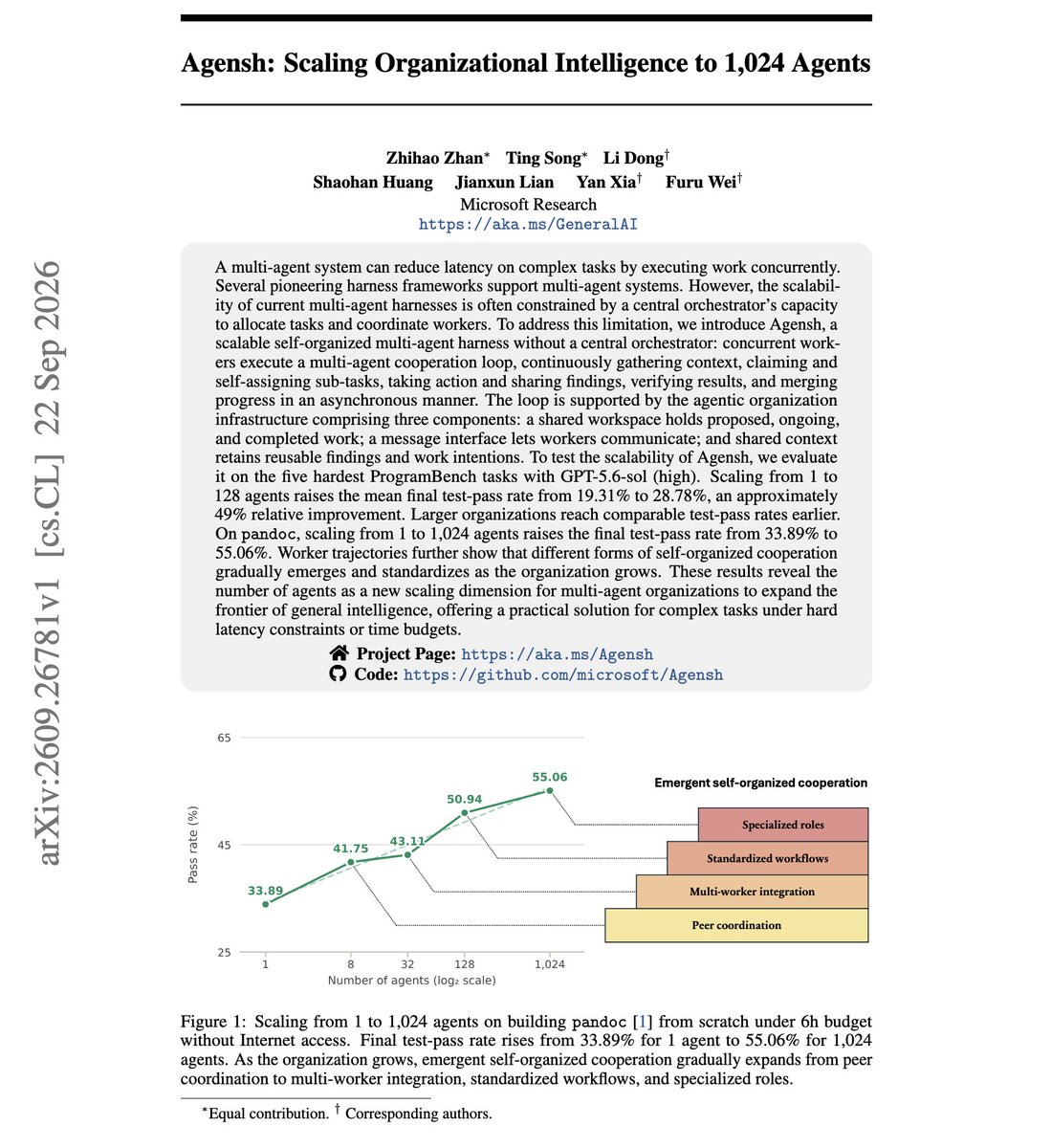
A post sharing a Microsoft Research paper says Agensh coordinates coding agents through shared state. Agents claim subtasks, share findings, verify results and merge changes asynchronously.

Ofir PressOP
elvisEL
13 Sources, 12d ago, first seen 12d ago

TLDR

A post sharing a Microsoft Research paper says Agensh uses a shared workspace and message channel to coordinate coding agents without a central orchestrator. On the five hardest ProgramBench tasks with GPT-5.6-sol, it says increasing the team from one to 128 agents raised the mean final test-pass rate from 19.31% to 28.78%. On a pandoc task, the post says 1,024 agents raised the test-pass rate from 33.89% to 55.06%. It also says the paper’s authors reported forms of cooperation that agents started on their own and that became standard practice as teams grew.

Combined views

40.4K

13 Sources, first seen 12d ago

411 likes68 comments494 saves66 reposts

Combined views

40.4K

13 Sources, first seen 12d ago

411 likes68 comments494 saves66 reposts

Sentiment

Positive——Negative

Summary

Not enough discussion yet.

No sentiment analysis available yet.

Featured Source

Sentiment

Positive——Negative

Summary

Not enough discussion yet.

No sentiment analysis available yet.

13 Sources

elvis@omarsar0Banger paper from Microsoft Research. (bookmark it) They run 1K+ coding agents at once to test a scalable self-organized multi-agent harness. This is an interesting test because most multi-agent systems today have some hierarchy or structure. Agensh has no central orchestrator. It coordinates parallel coding agents through a shared state instead of a central orchestrator. Each agent gathers context, claims a sub-task, does the work, shares what it found, verifies the result, and merges it, all asynchronously through a shared workspace and a message channel. On the five hardest ProgramBench tasks with GPT-5.6-sol, increasing agents from 1 to 128 raises the mean final test-pass rate from 19.31% to 28.78%. Larger teams also reach a given pass rate sooner. On pandoc, 1,024 agents take the test-pass rate from 33.89% to 55.06%. The authors also report forms of cooperation that the agents start on their own and that become standard practice as the team grows. Paper: https://arxiv.org/abs/2609.26781 Chat with Paper: https://academy.dair.ai/papers/agensh-scaling-organizational-intelligence-to-1-024-agents-2609.2678112d
John Yang@jyangballinAnother fantastic report on multi-agent coding agents gains on ProgramBench. MSR folks ran 1024 agents on FFmpeg, gromacs, pandoc, PHP-src, ctags (5 hardest PB tasks) and saw lift on all of them. Coolest finding is that the multi-agent orchestration is *self-determined*, there's no central lead!12d
Ofir Press@OfirPressRT @jyangballin: Another fantastic report on multi-agent coding agents gains on ProgramBench. MSR folks ran 1024 agents on FFmpeg, gromacs…11d
    • Home
    • Technology
    • Gaming
    • Entertainment
    • World & Business
    • Science
    • Sports
    • AI
    AgenshMicrosoft ResearchProgramBench

    13 Sources

    elvis@omarsar0Banger paper from Microsoft Research. (bookmark it) They run 1K+ coding agents at once to test a scalable self-organized multi-agent harness. This is an interesting test because most multi-agent systems today have some hierarchy or structure. Agensh has no central orchestrator. It coordinates parallel coding agents through a shared state instead of a central orchestrator. Each agent gathers context, claims a sub-task, does the work, shares what it found, verifies the result, and merges it, all asynchronously through a shared workspace and a message channel. On the five hardest ProgramBench tasks with GPT-5.6-sol, increasing agents from 1 to 128 raises the mean final test-pass rate from 19.31% to 28.78%. Larger teams also reach a given pass rate sooner. On pandoc, 1,024 agents take the test-pass rate from 33.89% to 55.06%. The authors also report forms of cooperation that the agents start on their own and that become standard practice as the team grows. Paper: https://arxiv.org/abs/2609.26781 Chat with Paper: https://academy.dair.ai/papers/agensh-scaling-organizational-intelligence-to-1-024-agents-2609.2678112d
    John Yang@jyangballinAnother fantastic report on multi-agent coding agents gains on ProgramBench. MSR folks ran 1024 agents on FFmpeg, gromacs, pandoc, PHP-src, ctags (5 hardest PB tasks) and saw lift on all of them. Coolest finding is that the multi-agent orchestration is *self-determined*, there's no central lead!12d
    Ofir Press@OfirPressRT @jyangballin: Another fantastic report on multi-agent coding agents gains on ProgramBench. MSR folks ran 1024 agents on FFmpeg, gromacs…11d
    Today's Rank

    —

    Not ranked yet

    Today's Rank

    —

    Not ranked yet