A paper published in Science on Oct. 8 reports that AlphaProof Nexus can produce machine-checked proofs for research questions that had resisted mathematicians. In one benchmark, the system proved 9 of 353 formalized problems from mathematician Paul Erdős; in another, it proved 44 of 492 conjectures drawn from the Online Encyclopedia of Integer Sequences.
Those results are sometimes summarized as 53 solved problems, but the paper treats them as two distinct evaluations. The Erdős set tested open research problems, while the sequence benchmark required extra checks to guard against conjectures that only looked true over a limited range.
How the proof loop works
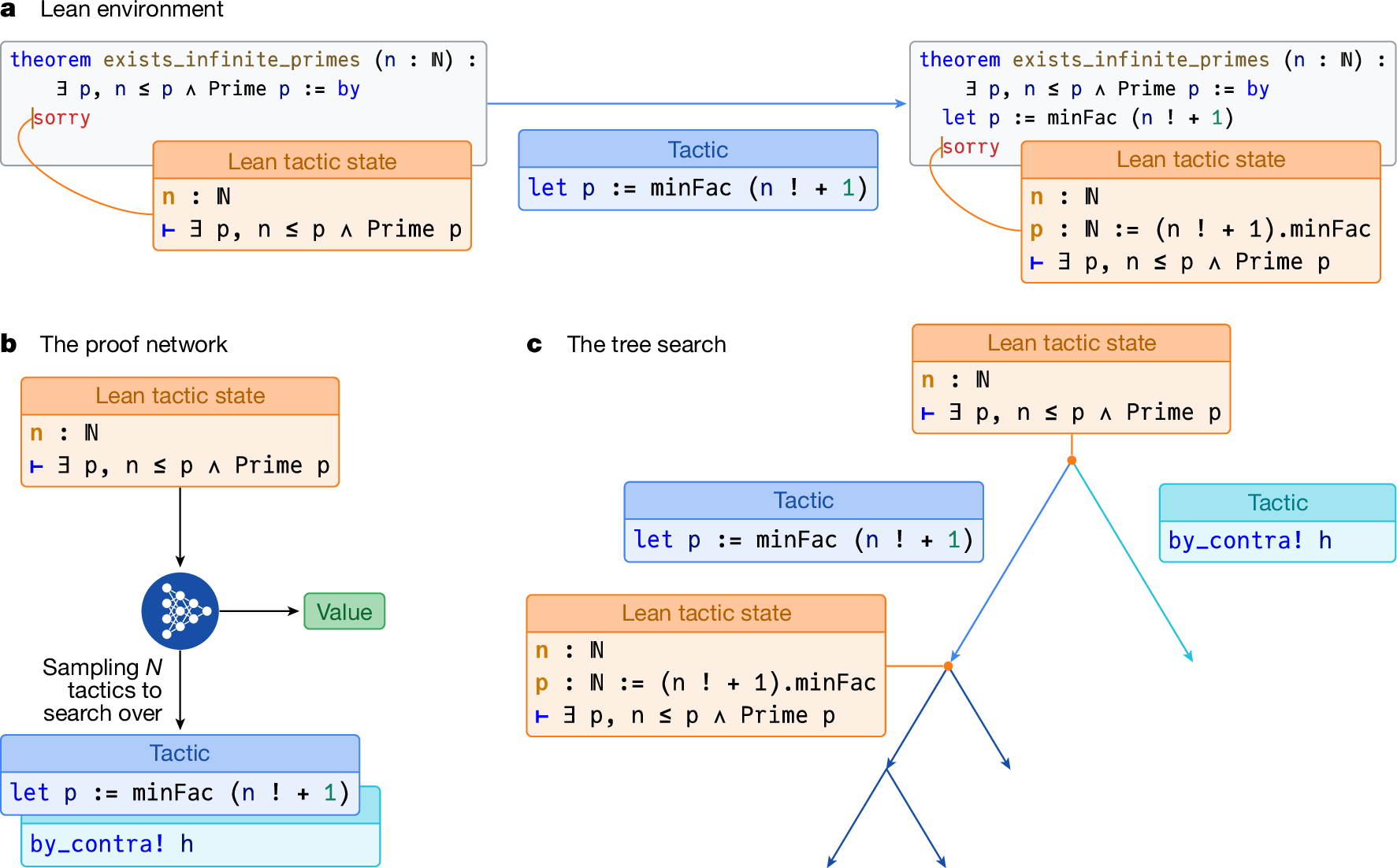
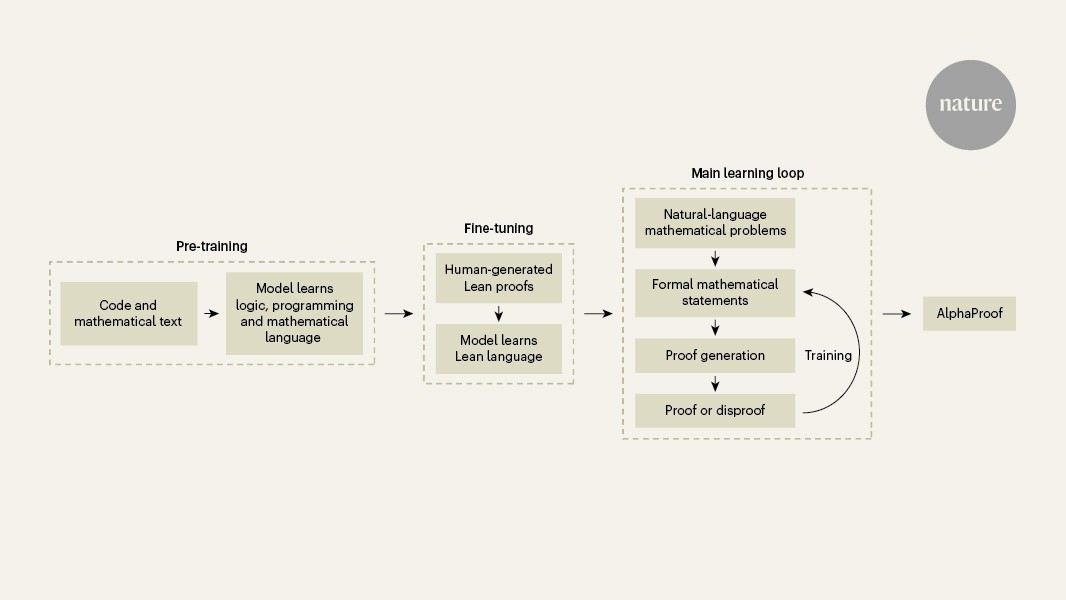
AlphaProof Nexus starts with a theorem or proof sketch written in Lean, a formal language in which every step can be checked by a computer. Gaps in the sketch are marked with sorry. Prover agents powered by Gemini 3.1 Pro propose edits, run the Lean compiler and use its error messages to try again. A result counts as a proof only when the file compiles with no sorry placeholders left.
The full system adds Google's AlphaProof model, keeps a population of competing proof attempts and uses language-model raters with an Elo-style ranking system to decide which attempts deserve more work. That combination lets it explore multiple approaches while Lean acts as a strict filter on the final derivation.
The researchers also ran a simpler version using only the language-model agents. In later, targeted runs it eventually solved the same nine selected Erdős problems, but the harder cases required more computation. That was not a repeat of the original search across all 353 problems, so it does not show that the simpler system would have found the same set independently.
A checked proof can still formalize the wrong question
Compilation proves that Lean accepts an argument for the theorem as written. It does not, by itself, prove that the formal statement captures the mathematicians' intended problem. Experts therefore compared the solved Erdős statements with their original formulations. They found some mistranslations, corrected them and had the system solve the corrected versions.
The sequence experiment used a related safeguard: before trying to prove a conjecture, the system first tested a lemma designed to expose simple counterexamples. The authors also manually reviewed the surviving results. These steps matter because failed proof sketches sometimes shifted the hard part into another sorry or invoked a literature result that did not exist. Requiring a complete Lean proof filters out those unfinished attempts, while human review checks the meaning around the formal artifact.
Google DeepMind has released the Lean files, selected readable proofs and build instructions, allowing specialists to inspect the verified results rather than relying only on the paper's summary.
Useful results, with clear limits
Beyond the two benchmarks, the paper describes collaborations in which the system helped address a 15-year-old question about Hilbert functions and contributed to problems in optimization, graph theory, additive combinatorics and quantum optics. The work presents the tool as a collaborator that can search formal proof space, not as a replacement for mathematicians who choose the questions, translate them into Lean and interpret what the proof means.
Most of the Erdős set remained unsolved. Success was strongest where Lean already had mature libraries and where problems could be broken into smaller formal steps. The underlying language models also inherit uneven knowledge from their training data.
The paper puts the inference cost for each successful Erdős problem at a few hundred dollars. That figure does not capture the larger investment required to search the full collection. For now, the headline result is narrower than a general-purpose automated mathematician: a system that can occasionally find new research-level proofs, with a proof assistant checking every formal step and people still responsible for the mathematical target.