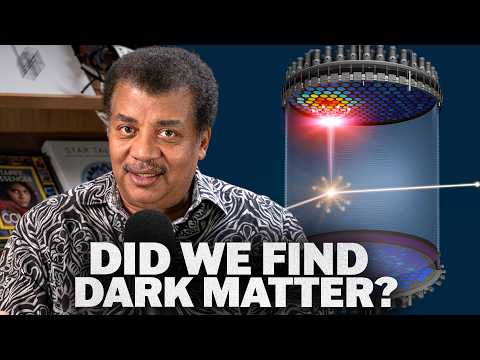
The LUX-ZEPLIN experiment has not discovered dark matter. It has found something more modest and, for particle physicists, unusually provocative: one very energetic nuclear recoil that is difficult to explain cleanly.
The event appeared in a 2.84 tonne-year exposure of LZ's liquid-xenon detector. A xenon nucleus recoiled with an energy of about 248 kiloelectronvolts, while the data did not show the lower-energy recoils that most ordinary dark-matter interactions should also produce. As Science News reported, the signal could have come from a dark-matter particle, but it could also be a fluctuation or a known physical process. One event is nowhere near enough to settle the question.
Why a higgsino fits the shape
The odd energy pattern has put a familiar candidate back in the conversation: the higgsino, a hypothetical partner of the Higgs boson predicted by supersymmetry. Supersymmetry proposes a heavier partner for every known particle. No such partner has turned up in collider searches, which is one reason the theory has lost ground in recent years.
A higgsino could interact with xenon in a way that naturally filters out low-energy collisions. In this model, the particle has two closely spaced mass states. A collision can happen only when an incoming higgsino carries enough energy to jump from the lighter state to the heavier one. Slower particles do not clear that threshold, so they do not create the low-energy recoils that LZ failed to see.
A theory preprint found that the event's energy and rate could be consistent with a thermal higgsino weighing about 1.1 teraelectronvolts, with a mass-state gap of roughly 370 to 490 kiloelectronvolts. The exact gap depends on assumptions about the fastest dark-matter particles moving through the Milky Way.
If that interpretation held up, it would do two jobs at once: identify dark matter and provide the first evidence for a supersymmetric particle. That explains the burst of theory papers after LZ announced the event. It does not make the explanation likely.
Two checks put the idea under pressure
The first problem comes from LZ's own higher-energy data. Researchers studying a high-energy sideband calculated that a higgsino capable of producing the 248 keV recoil should generally create still more energetic recoils. LZ reported none in that bin.
That comparison is not conclusive because the detector was not calibrated for those higher energies and its acceptance there was not public. An LZ spokesperson told Science News that the collaboration made no formal claim about either a detection or a nondetection in that region. Even with that caveat, the missing events create a tension the collaboration can test with a dedicated analysis.
The second problem comes from the Sun. Its gravity could capture higgsinos after they scatter from matter inside it. Pairs of the trapped particles would then annihilate, producing high-energy neutrinos that could reach Earth. A separate preprint on solar capture compared that expected signal with IceCube's failure to see high-energy neutrinos from the Sun. For a cosmologically favored higgsino mass near 1.08 teraelectronvolts, the authors derived a mass-gap limit above 566 kiloelectronvolts, outside the range used to explain the LZ event.
Both results are model-dependent preprints, not final verdicts. Assumptions about the Milky Way's fastest dark-matter particles, the higgsino's mass and the detector's response at extreme energies all matter. Researchers have proposed heavier higgsinos and alternative inelastic particles that could preserve parts of the explanation without satisfying the standard supersymmetry picture.
The next data matter more than the name
The immediate question is not whether physicists have found a higgsino. It is whether the lone recoil repeats. More LZ exposure could reveal similar events or show that the first one was an outlier. XENONnT, another liquid-xenon dark-matter experiment, is also checking its data for high-energy recoils.
A repeatable population with the same unusual energy pattern would make the particle interpretation much harder to dismiss. A continued absence of events in LZ, XENONnT and IceCube would squeeze the higgsino explanation further. For now, the signal is best treated as an interesting clue that has revived a famous theory while also exposing exactly where that theory struggles.