• Home
  • Technology
  • Gaming
  • Entertainment
  • World & Business
  • Science
  • Sports
  • AI
HomeTechnologyGamingEntertainmentWorld & BusinessScienceSportsAI
Science
Announcement

Webb study of rare extreme debris disks points to two kinds of planet-shattering collisions

Webb and Spitzer observations of 21 rare extreme debris disks found silica-rich and silica-poor groups that may reflect different collision energies in young stellar systems.

NASA Webb TelescopeNW
3 Sources, 8d ago, first seen 8d ago

TLDR

Webb and Spitzer observations of 21 rare extreme debris disks sorted them into silica-rich and silica-poor groups that may reflect high-energy impacts between Mars-sized bodies or smaller-scale collisions involving Moon-sized objects. NASA says the results could help compare other young systems with the early solar system, but those parallels remain conditional rather than confirmed.

Combined views

127.9K

3 Sources, first seen 8d ago

862 likes13 comments62 saves96 reposts

Combined views

127.9K

3 Sources, first seen 8d ago

862 likes13 comments62 saves96 reposts
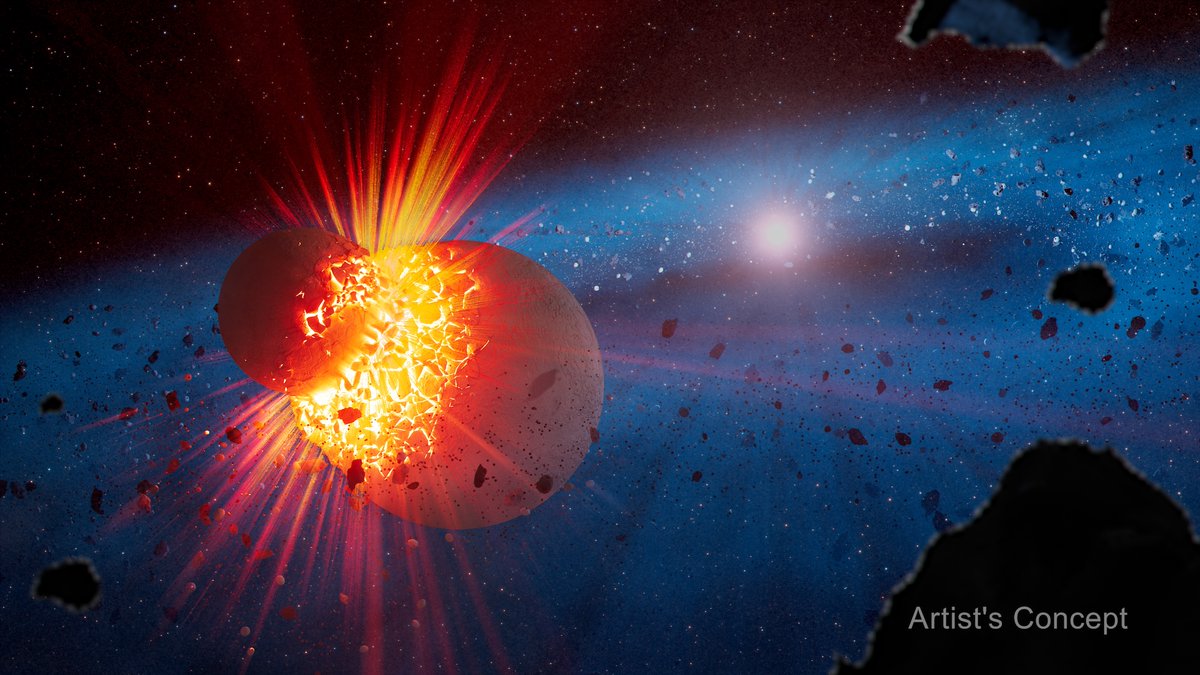
Artist’s concept of a star and its debris disk against the black background of space. The star is in the background, right of center, and depicted as a small, luminous sphere. The debris disk is a large blue ring that encircles the star. The debris disk is angled toward the viewer, so that the portion nearest to the viewer extends beyond the bottom frame of the illustration. Many dark, rocky fragments are scattered throughout the debris disk. In the foreground, toward the left, is a small planetary embryo colliding into the left side of a larger spherical object. The impact site glows bright yellow and orange and has a mottled appearance, as though chunks of both colliding bodies are breaking up and being destroyed. Orange-yellow streams of vapor extend outward from the collision area. Behind the debris disk and its star are many small stars in the background. A label in the bottom right corner reads “Artist’s Concept.”

Astronomers used the James Webb Space Telescope to examine a rare class of young stellar systems called extreme debris disks, which show signs of upheaval and may offer clues about the energy involved in their collisions. In NASA’s summary of the research, the agency says the findings were published Thursday in The Astrophysical Journal.

Featured Source

Extreme debris disks are unusual enough that NASA says only about 1% of young stars show observable signatures of this phase, based on current observations. For this study, the team compiled 21 such systems: five from Spitzer archival data and 16 from Webb, including 12 newly observed disks and follow-up observations on four Spitzer targets, according to NASA’s write-up.

Two composition groups, and what NASA says they may mean

From that sample, the team found that the disks could be sorted into silica-rich and silica-poor groups, according to NASA’s summary of the paper. NASA says that split may help explain what kinds of collisions produced the debris.

In NASA’s account, about one-third of the sample is silica-rich, which the agency says suggests high-energy impacts between Mars-sized bodies, with enough force to vaporize a significant portion of the material. The remaining two-thirds are silica-poor, which NASA says points to smaller-scale collisions such as grazing impacts between Moon-sized objects. In a related NASA Webb post on X, the agency similarly said silica-rich disks seem to come from high-energy impacts, while silica-poor ones might form through smaller-scale collisions across a wider range of ages.

Why NASA is comparing them with our solar system

NASA says the findings may help researchers compare these young systems with models of the early solar system. In the agency’s account, the ages of the silica-rich disks observed so far fit with estimates that Earth and the Moon formed around 100 million years after the Sun formed, with the Moon likely resulting from a collision between Earth and a Mars-sized object.

NASA says that if older silica-poor disks and their irregular infrared brightening do reflect orbital instability, that would be broadly consistent with the Late Heavy Bombardment hypothesis for our solar system. That comparison depends on the condition NASA spells out, rather than establishing that our solar system definitely passed through the same phase in the same way.

NASA’s social posts leaned into that broader framing. In one post on X, the agency described planet formation as involving “violent collisions” and said Webb is helping compare other young stellar systems to our own.

Sentiment

Positive——Negative

Summary

Not enough discussion yet.

No sentiment analysis available yet.

Sentiment

Positive——Negative

Summary

Not enough discussion yet.

No sentiment analysis available yet.

Related

Webb reveals stars of different ages in a dusty nebula

NASA says infrared light let Webb peer through the nebula’s dust, helping scientists study how stars change over time.

A young star cluster filled with many stars that display Webb’s unique eight-pronged diffraction pattern. At its center is a yellow star which sports the largest diffraction pattern. To the left of the star, there is a region filled with yellow dust and gas. This yellow region extends from the bottom, covering about two-thirds of the image. The yellow region has several blue stars of different sizes embedded within. The top third, which lies outside of the yellow region, holds a few bright protostars, within dense gray gas. Those stars illuminate the gas, making it appear blue. A few red outflows from other protostars are visible above this grayish-blue region. To the right of the central star, there is a clumpy, flame-like plume of red dust and gas with protostars that emit a soft white light within. The plume is surrounded by more dense gray gas and dust.
Webb identified the host galaxy of the most distant fast radio burst yet

NASA says the James Webb Space Telescope found an actively star-forming dwarf galaxy 1,000 times less massive than expected.

A field full of small galaxies of all shapes against the blackness of space. A few bright white stars show 8 prominent diffraction spikes. A small galaxy at lower right is highlighted with a white box. A shaded triangle extends upward to the corners of a larger box showing a zoom in of the region. Two fuzzy, light blue blobs are at center, with a larger and brighter one at top. Just above the top blob is a white crosshair showing the location where a fast radio burst was detected.
NASA Webb teases a new image in World Space Week post

NASA Webb said in an X post for World Space Week that people searching for space facts might come across the telescope’s newest image, but the post itself did not include details about the image.

A young star cluster filled with many stars that display Webb’s unique eight-pronged diffraction pattern. At its center is a yellow star which sports the largest diffraction pattern. To the left of the star, there is a region filled with yellow dust and gas that extends from the star to the left border of the image. This yellow region extends from the bottom, covering about two-thirds of the image. The yellow region has several blue stars of different sizes embedded within. The top third, which lies outside of the yellow region, holds a few bright protostars, within dense gray gas. Those stars illuminate the gas, making it appear blue. A few red outflows from other protostars are visible above this grayish-blue region. To the right of the central star, there is a clumpy, flame-like plume of red dust and gas with protostars that emit a soft white light within. The plume is surrounded by more dense gray gas and dust. 

Image credit: NASA, ESA, CSA, STScI, Processing: Alyssa Pagan.

4 Sources

NASA ScienceNASA’s Webb Provides Crash Course on Planet-Shattering Collisions - NASA Science8d
NASA Webb Telescope@NASAWebbThey say planet formation’s a cruel endeavor Violent collisions, like that between a proto-Earth and a Mars-sized object named Theia 4.5 billion years ago, shaped our home planet. Webb is helping compare other young stellar systems to our own. https://go.nasa.gov/4rL1UpN8d
    • Home
    • Technology
    • Gaming
    • Entertainment
    • World & Business
    • Science
    • Sports
    • AI
    WebbNASA Webb Telescope

    4 Sources

    NASA ScienceNASA’s Webb Provides Crash Course on Planet-Shattering Collisions - NASA Science8d
    NASA Webb Telescope@NASAWebbThey say planet formation’s a cruel endeavor Violent collisions, like that between a proto-Earth and a Mars-sized object named Theia 4.5 billion years ago, shaped our home planet. Webb is helping compare other young stellar systems to our own. https://go.nasa.gov/4rL1UpN8d
    Today's Rank

    —

    Not ranked yet

    Today's Rank

    —

    Not ranked yet