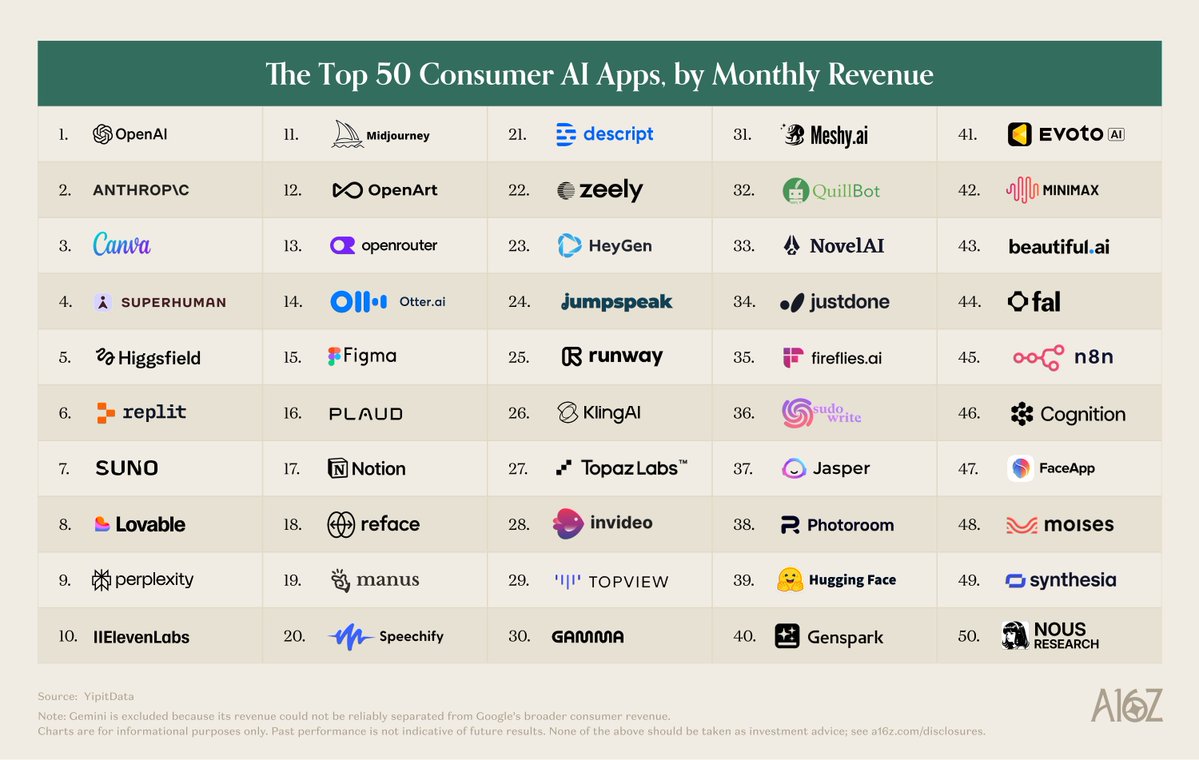
Andreessen Horowitz has updated its recurring consumer AI ranking, and this time the firm says the list has grown from 100 entries to 150 while adding revenue data from YipitData to show not just where people spend time, but where they spend money on AI (Olivia Moore on X).
That added revenue view is also the main point of the update. In a16z’s telling, consumer AI spending is highly concentrated among heavy users, with the firm saying the top 1% of AI spenders now outspend the bottom 50% combined. According to a16z, that top 1% spends an average of $903 a month, while the median customer spends $25 (a16z on X).
The result is a ranking that looks a little different depending on whether you measure attention or willingness to pay. a16z says Replit is a top 10 consumer AI app by spend but a bottom 5 app by traffic, which the firm presents as a sign that monetization and usage do not necessarily move together.
Where a16z says the money is going
On the revenue side, a16z says the heaviest spenders are especially likely to pay for products aimed at building and automation rather than broad casual use. The firm says the top 1% of spenders are 23 times more likely than the average spender to pay for n8n, 18 times more likely to pay for fal and Manus, and 15 times more likely to pay for Higgsfield (a16z on X).
That helps explain why an app can look relatively niche by traffic and still rank highly by revenue. The update does not suggest every popular AI product has cracked mainstream consumer habits in the same way; it suggests some products are finding a lucrative base among more invested users.
Mainstream subscriptions still look very non-AI
a16z also argues the broader consumer subscription market is still dominated by older media habits. The firm says 13 of the 20 biggest consumer subscription bases are media, and that ChatGPT is the first AI app to crack the top 20 (a16z on X).
That is a notable milestone for ChatGPT, but it also doubles as a reminder that AI subscriptions are still competing with entrenched entertainment products for recurring consumer dollars.
The bigger gap may be product design
Some of the most revealing commentary in the update is less about rankings than about what consumer AI still has not solved. In a post shared by a16z, partner Josh Elman argued that for many non-technical users, an AI agent still feels like a “blank box.” “Coders get it instantly, but for everyone else it’s just not intuitive,” he wrote, arguing that solving that problem is key to reaching “the next few hundred million real adopters” (Josh Elman on X).
Olivia Moore made a related argument in another a16z post, saying many AI products so far have been built around doing existing tasks “a little bit faster” or “a little bit easier,” which she said is “not an incredibly compelling daily or hourly active value proposition for most people” (a16z quoting Olivia Moore on X).
That helps frame another data point from the update: a16z says 9 of 15 consumer internet categories still have zero AI products in the Top 100, including streaming, social, dating, gaming, travel, retail, finance, real estate and jobs (a16z on X). If that count holds, the gap is not just that existing AI apps need better onboarding. It is also that some of the biggest consumer categories still apparently do not have many breakout AI-native products at all.
Taken together, the updated ranking is less a victory lap about AI becoming a mass-market consumer habit than an argument about how uneven that shift still looks. Plenty of people are trying AI tools. But by a16z’s own numbers, a relatively small group of power users is doing a lot of the paying, and some of the most familiar consumer categories still have not produced many AI standouts.